Showing posts with label Trekking. Show all posts

Wednesday, April 21, 2010

TREKKING IN THE HILLS OF CHIANG DAO, CHIANG MAI PROVINCE

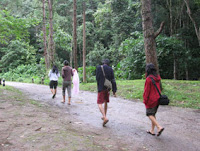
Chiang Dao is located to the north of Chiang Mai, on the way to Fang and Tha Ton. Treks to the highest peaks of Doi Chiang Dao will provide you with spectacular sights of stunning mountain scenery. The cool season (December to February) is the best time to visit here since the forests have their own special beauty as the leaves change colour and wild orchids bloom.

Monday, November 23, 2009

BEST TIME TO HIKE & CAMP

Depending on your interest, visits to the national parks can be awe-inspiring especially during the cool season during November – Febuary when trekkers are rewarded with a view of thick mist. However, if you prefer having stopovers at waterfalls, this is only possible during the rainy season of July-October when the falls are at their most intimidating. There is no bad time to hike or camp even if it’s during the rainy season or the dry season, this is because exhaustion from jungle treks is minimal due to the dense foliage from the tropical rain forests that keep temperatures within parks a cool 30 degrees Celsius and below. However, hiking and camping during the rainy season can be dangerous as areas with waterfalls are susceptible to sudden water swells that pour down the falls. All national parks do have a warning system of sirens and flashing lights to warn hikers and swimmers of this. These warning MUST be heeded and should not be taken lightly as these research on what to do and where. Another great website that must be visited is http://www.umphanghill.com/; where Umphang National Park’s various sights and activities are listed. Other private sector websites worth visiting are http://www.lisulodge.com , www.thaiecotours.com and http://www.wildwatchthailand.com/

Thursday, August 13, 2009

HIKING & CAMPING: SOUTHERN THAILAND

Within southern Thailand, national parks are typically more dense with mangrove swamps and wetlands. Here lies Phru To Daeng or Phru Sirindhorn in Narathiwat, which is one of the world’s largest peat swamps. In Khao Chong Wildlife Development and Conservation Promotion Station in Trang, pleasant walking trails through streams and waterfalls are part of the attractions.

Tuesday, August 11, 2009

HIKKING & CAMPING: NORTHERN THAILAND

Vegetation in the north is less congested when compared to a typical tropical rain forest. Here cool to temperate-weathered vegetation can be found such as the Wat Chan Pine Forest located in Chiang Mai at Wiang Ping. Also located here is Mae Ya Waterfall in Doi Inthanon (Thailand’s highest mountain), dropping more than 25 metres at southern end of the park. Treks to the highest peaks during the cool season will take you to a view of a sea of thick mist and fog. Virtually all peaks in northern Thailand enables viewing of mist however, noteworthy view points for this spectacular sight are Doi Inthanon Natioanl Park, Huai Nam Dang National Park (Kiew Lom View Point), Mae Wong National Park (atop Mokochu Mountain), Phu Chi Fa in Chiang Rai and lots more.

HIKING & CAMPING: WESTERN THAILAND

Thailand’s national parks are well endowed with great waterfalls which are a great stop-over point for trekkers and bikers alike. Among the more famous and fantastic of them are Erawan Falls (probably the country’s most famous waterfall) at Erawan National Park. A noteworthy itinerary is provided by some operators that combine an interesting route to national parks. For instance, cycle or travel by mini van to Phetchburi province from Bangkok, followed by a short sea canoe experience across the bay to get to Sam Roi Yod National Park (which is also accessible by road). Upon arrival to Sam Roi Yod , take a 1.5 hour trek to the Tham Phraya Nakhon, a cave located at the top of the hill. The cave has a large opening which lets in a stream of light upon, Khuha Karuehat – an antique Gazebo constructed by King Rama V.

Friday, August 7, 2009

HIKING & CAMPING: CENTRAL THAILAND

Nature treks in Thailand are as diversified as its 5 different regions. Within central Thailand where Khao Yai National Park is located, vegetation are typically lush tropical forests with a large number of wildlife particularly wild elephants, red bull, gaur and horn bills. Khao Yai offers night time animal watch trekking as well as viewing platforms.
The overwhelming 18-tired Tho Thip waterfall in Kaeng Krachan National Park is also located within the central region and it best visited during the rainy seasons from July to early October. During the cool season between November to January, treks to the highest peaks will be rewarded with an awe-inspiring view of a sea of thick mist and fog. This can be viewed within Khao Yai National Park at Lonely Peak (Khao Yai’s highest peak).

HOW TO GET START TREKING

Depending on your interest, the national parks offer a great number of activities within the protected areas. To fill your time in the parks, you can go on jungle treks, trekking and wildlife observation, bird watching, mountain biking and river rafting (this includes bamboo rafting and white water rafting). Each national park within Thailand is managed independently therefore it is best to consult a travel company specializing in ecotourism and adventure travel to identify the best itinerary for you. Being in Thailand, jungle treks by elephant back is also an interesting option. Some tour operators also provide interesting treks past tribal communities especially in northern Thailand where visits and home stays within hill tribe families can be arranged. On rare occasions, some travel operators offer rides on ox-carts through small villages in the outskirt of national parks.

Friday, July 17, 2009

TREKING & CAMPING IN THAILAND

Thailand is definitely one of the best place in the world for hiking and camping as there are an abundant number of national parks in the country. It should be stated that Thailand has the largest areas of protected forest areas in Southeast Asia and therefore hikers will find lots to do here. There are almost 50 national parks in Thailand; this number includes marine parks. These parks are managed and run by the national Parks Division of the Royal Forestry Department, and all offer great cottages and guesthouses. For those who prefer to camp out in the wilderness, national parks do allow visitors to pitch tents within specified areas.

Unlike the rest of the country, you will find that the parks are relatively cool all year round with temperatures averaging 30 degree Celsius. In fact, at year’s end (November-December during the cool season) parks can be quite chilly. Of course, being the tropics, these parks are also very humid (humidity here is almost 99%). A constant complaint for campers is that most washing never really dries even in the sunniest days due to the high levels of humidity.

Within Thailand’s national parks are also great waterfalls, which are a great stopover point for trekkers and bikers alike. Among the more famous and fantastic of them are Erawan Falls (probably the country’s most famous waterfall) located in Erawan National Park in western Thailand.

Friday, November 7, 2008

FOREST TREKKING : NORTHERN FORESTS

From the young world travelers of the 1970s who organized informal groups to explore the mountain forests of northern Thailand, the trekking industry has developed rapidly in the northern capital of Chiang Mai. There are innumerable trails through jungle terrain, across flower-strewn meadows, beside fast-flowing streams. Chiang Mai’s Pai District and Ma Hong Son’s Mae Chan have the biggest selection for first-time or experienced trekkers. Further off the beaten track, the rugged back-country around Phrae and Nan, or between Chiang Rai and Fang, offer new paths into the unknown. Along the trail, trekkers meet the hilltribe people who make their homes in the area: Karen, Lisu, Akha, Hmong, Lawa and Meo, each with their distinctive traditional dress. A typical hilltribe tour trekkers, a guide, a cook, overnight stays in hilltribe villages and a hike of four, five or even ten days.
While trekking has become a more upmarket industry—often with elephant rides and raft trips included in the package—the slog up and down mountains, coupled with hot sun, drenching rain and basic food, still demands youthful stamina.
The Kok River is a favourite thoroughfare for visits to hilltribe north and south of its banks. At riverside town of Tha Thon, hiking and rafting can be arranged. The rafts may be either traditional bamboo craft or inflatable.
West of Chiang Mai near the Myanmar border, Mae Hong Son has guesthouses which specialize in hilltribe treks. South of Chiang Mai, in Tak Province, the small town of Umphang is populated mainly by Karens, and is a popular jumping-off point for treks to more remote villagers.

Tuesday, October 28, 2008

RIDING A JUMBO

Siamese soldiers rode elephants into battle as the tanks of ancient battlefields. Now tourists can ride one, too. Though you can go for an elephant trek on many Thai islands, the most scenic outings are up in the great green north. Atop the elephant’s back you can climb hills, ford streams and lumber through the jungle. Some of the camps also put on shows. For an incredible display of the animal’s might, just watch them hauling logs. At the National Elephant Institute, in the northern province of Lumpang tourists can also sign up for courses on how to be a mahout. Learn how to ‘drive’ the beast, how to take them to the river for a bath, and even sleep with your own elephant out in the jungle. Please bear in the mind that these intelligent and endangered creatures, which have the same lifespan as a human being, are sacred to Thai people and that a white elephant once graced the flag of Siam. Even today, you can still see Thais walking under the elephant’s belly, like ancient Siamese warriors used to do, in order to bring themselves good luck and strength.

Monday, October 27, 2008

ON TOP OF THAILAND

Imagine climbing down a cliff face with a gushing waterfall on both sides of you. That’s the thrill of abseiling in Khao Yai National Park, which has been named a UNESCO World Heritage Site for its diverse eco-systems and 800 different species of fauna. The park is also renowned for its waterfalls, ranging from 15 to 50 meters high. Abseiling (or walking backwards) down them is a thrill sport that will make you feel like Spider-man.

But there are more than just chills and spills to fill out a day in the park. To get to some of the waterfalls requires kayaking across a lake, or trekking through some of the most luscious greenery in the Kingdom. And the jungle is a lair for wild elephant herds, gibbons and hornbills. Even Spider-man never got this wild.

Friday, January 4, 2008

ESCAPE FROM THE CONCRETE JUNGLE

ESCAPE FROM THE CONCRETE JUNGLE
The West’s concrete jungle now threatens the world, but if you want to see the real thing, genuine primary forest that has never been disturbed except by you, it is only two to three hours drive from Bangkok. Go west to Kaeng Krachan National Park, the country’s largest pristine forest that offers superb walking trails to study nature. Be prepared from some truly awe inspiring trees, 70 metres tall and more. Where the forest is open, it is like being inside a cathedral. Most of the trails cluster around the single 36-kilometre road inside the park, but serious jungle treks of up to two weeks through rugged terrain can also be organized. Perhaps the best trip is to the 18-tier Tho Thip Waterfall, a full day’s outing with about three hours walking each way.

If that sound a bit too serious, drive north instead to Khao Yai National Park, the country’s oldest and third largest. It takes about the same time to reach and has at least 13 trails of varying levels of difficulty. Although these are more popular than those at Kaeng Krachan, you will still be in or near real jungle, so take a guide and keep your eyes peeled for the local wildlife. Other excellent walking trails can be found at Khao Chamao-Khao Wong National Park, an easy drive from Rayong on Eastern Seaboard, at Chalerm Rattanakosin National Park in Kanchanaburi and, closet of all to Bangkok, at Nakhon Nayok about an hour’s drive north of city. Almost all parks have at least some accommodation and food. Park staff at the headquarters will be able to advise you on the best walks. You will see spectacular caves, fantastic waterfalls, dramatic vistas of forest as you wind up hill and down dale and follow the banks of crystal streams. The trails were often originally made by elephant. Concrete? Give me a break!

Thursday, January 3, 2008

LIFE IN THE WILD

In the past, abundant wildlife could be found as close to Bangkok. A local writer once noted that “five to six hundred species of plants are know to grow wild in Bangkok” Although this magnificent cornucopia of plants, herbs and animals is less evident now than then, it still exists. Some of the best places to study it are the central region’s wildlife sanctuaries, research and breeding stations, open zoos and national parks. Huai Kha Khaeng and Thung Yai Naresuan wildlife sanctuaries in Uthai Thani and Kanchanaburi provinces respectively are the best places to start. These contain such superb creatures as guar, the massive yet shy forest ox, and banteng, the wild red cattle. They also contain well over 40 other mammal species including bears, leopards, tigers, elephant, tapir, deer, gibbons, monkeys and macaque as well as a wide range of vegetation types.
Khao Yai National Park is another excellent nature study site as many wildfire research projects on such creatures as gibbons, tigers and hornbills are being conducted here.
Khao Khieo Wildfire Sanctuary in Chon Buri province has an open zoo which makes its wildlife particularly accessible. Species include gaur, dusky langur, barking deer and brow-antlered deer. In one of the largest aviaries in the world, it also has the Sarus Crane and black necked Stork which may one day be re-introduced to the wild. Its breeding station supports and studies many other species. It also has the only elephant twins born in captivity. Three types of crocodile are being bred and studied at the nearby Crocodile Farm while over in Kanchanaburi’s Sadong Research Station, banteng, sambar and serow, a kind of goat-antelope are being studied and bred. Not only is Thailand’s amazing wildlife as prolific as ever, but through activities such as these it is also more accessible than ever before. And it will remain safe into the future.