Showing posts with label Nature Watch. Show all posts

Tuesday, January 29, 2008

THAILAND'S TREASURES

Thailand’s the hub of youth travel in Southeast Asia. It is ideally placed geographically for people exploring the region and is well served by major airlines. But the kingdom would not have achieved its status as one of the world’s premier travel destinations without its fabulous wealth of natural, historical and cultural treasures. For more than 20 years Thailand has been drawing young travelers from all over the world. Here they delight in the country’s physical beauty and its ancient heritage, feast on a cuisine that is one of the best anywhere, and enjoy the fabled warmth and friendliness of its people. The country has responded to this attention enthusiastically, opening itself further by developing a sophisticated tourism industry. Travel in the kingdom is easy, safe and cheap, and Thailand boasts a vast range of accommodation to meet the demands of young international tourists. Attractive, well-priced and convenient, this makes a visit to the kingdom even more relaxing and rewarding. Thailand’s traveler-friendly sentiment is even more prevalent today. Tourism, particularly youth tourism, is on the increase, and Thailand is positively encouraging it in the 21st century, hoping to welcome more young visitors than ever before.

Thursday, January 17, 2008

WRITTEN IN THE STARS

If you go to any colourful Thai market and even to some placid Buddhist temples, you will find in some quiet corner an astrologer waiting for custom. He will ask the date and time of your birth. With that scant information and his zodiacal charts, he’ll tell your fortune. It has been that way for thousands of years. But then about 150 years ago, a new form of knowledge of the stars, western astronomy, came to Thailand. It was brought here by one of this country’s greatest kings, Rama IV or King Mongkut. The king was so enthused with this new knowledge that he ordered an observatory built at his hilltop palace in Phetchaburi province. He quickly became adept and predicted a total eclipse of the sun near Prachuab Khiri Khan on August 18, 1868. Almost everyone was skeptical, including the court astrologers who believed such an event was impossible. So a great expedition was organized to what is now Khao Sam Roi Yot National Park to which many foreign scientists were invited. There, the king’s prediction was dramatically confirmed-a six-minute total solar eclipse that had the court astrologers calling out in awe. Today, star-gazing is practiced by anyone with binoculars or their own telescope. You can even join the Thai Astronomical Society on one of their regular trips. Generally, these go off to a remote location such as a hilltop in a national park or an island in the gulf where the night sky is clear. You can either share their big telescope or use your own equipment. Or of course you can follow in King Mongkut’s steps. His Phetchaburi observatory is still there and so is Phra Chomklao Science Museum at Wah Kor.

Thursday, January 10, 2008

MANGROVE FOREST

Time was when every tidal mud flat in the Gulf of Thailand was covered by mangrove forest-all 744 square kilometers of it. Now, much of this vegetation that thrives in salt and brackish water and fosters some of the most productive environments on Earth. But enough remains-and more is being regenerated-for you to see what it is. As a first impression, it’s spooky. A good place to start is Khao Sam Roi Yot National Park in Prachuab Khiri Khan where the mangroves are extensive and well-developed enough to generate some atmosphere. You’ll find yourself navigating an eerily quiet, enclosed world, moving from one twisted exposed root to the next. The canopy is barely above your head and lateral vision and orientation is similarly limited by the roots around you. But this protected world is an ideal habitat for a wide variety of land and water life. As all this goes about its business-the small creatures finding shelter, the larger ones food-the mangroves feed off their own fallen and decomposed leaves and constantly colonies new territory. They thus protect the coastline from storms and help to build up new land. Their timber was greatly prized for firewood and charcoal as were the barks of some species for dye. Mangroves were particularly valuable when the central Thai lifestyle was water-based. Most easily accessible by small boat, they were a kind of larder. Today, much of the cultural ambience of mangroves has been lost as food comes more easily from the local store and cooking fuel out of a gas canister. But search out your own small patch somewhere along the coast and spend some time in it. This was an important part of what it was to be a coast-living Thai.

Friday, January 4, 2008

ESCAPE FROM THE CONCRETE JUNGLE

ESCAPE FROM THE CONCRETE JUNGLE
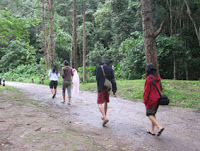
The West’s concrete jungle now threatens the world, but if you want to see the real thing, genuine primary forest that has never been disturbed except by you, it is only two to three hours drive from Bangkok. Go west to Kaeng Krachan National Park, the country’s largest pristine forest that offers superb walking trails to study nature. Be prepared from some truly awe inspiring trees, 70 metres tall and more. Where the forest is open, it is like being inside a cathedral. Most of the trails cluster around the single 36-kilometre road inside the park, but serious jungle treks of up to two weeks through rugged terrain can also be organized. Perhaps the best trip is to the 18-tier Tho Thip Waterfall, a full day’s outing with about three hours walking each way.

If that sound a bit too serious, drive north instead to Khao Yai National Park, the country’s oldest and third largest. It takes about the same time to reach and has at least 13 trails of varying levels of difficulty. Although these are more popular than those at Kaeng Krachan, you will still be in or near real jungle, so take a guide and keep your eyes peeled for the local wildlife. Other excellent walking trails can be found at Khao Chamao-Khao Wong National Park, an easy drive from Rayong on Eastern Seaboard, at Chalerm Rattanakosin National Park in Kanchanaburi and, closet of all to Bangkok, at Nakhon Nayok about an hour’s drive north of city. Almost all parks have at least some accommodation and food. Park staff at the headquarters will be able to advise you on the best walks. You will see spectacular caves, fantastic waterfalls, dramatic vistas of forest as you wind up hill and down dale and follow the banks of crystal streams. The trails were often originally made by elephant. Concrete? Give me a break!

Thursday, January 3, 2008

LIFE IN THE WILD

In the past, abundant wildlife could be found as close to Bangkok. A local writer once noted that “five to six hundred species of plants are know to grow wild in Bangkok” Although this magnificent cornucopia of plants, herbs and animals is less evident now than then, it still exists. Some of the best places to study it are the central region’s wildlife sanctuaries, research and breeding stations, open zoos and national parks. Huai Kha Khaeng and Thung Yai Naresuan wildlife sanctuaries in Uthai Thani and Kanchanaburi provinces respectively are the best places to start. These contain such superb creatures as guar, the massive yet shy forest ox, and banteng, the wild red cattle. They also contain well over 40 other mammal species including bears, leopards, tigers, elephant, tapir, deer, gibbons, monkeys and macaque as well as a wide range of vegetation types.
Khao Yai National Park is another excellent nature study site as many wildfire research projects on such creatures as gibbons, tigers and hornbills are being conducted here.
Khao Khieo Wildfire Sanctuary in Chon Buri province has an open zoo which makes its wildlife particularly accessible. Species include gaur, dusky langur, barking deer and brow-antlered deer. In one of the largest aviaries in the world, it also has the Sarus Crane and black necked Stork which may one day be re-introduced to the wild. Its breeding station supports and studies many other species. It also has the only elephant twins born in captivity. Three types of crocodile are being bred and studied at the nearby Crocodile Farm while over in Kanchanaburi’s Sadong Research Station, banteng, sambar and serow, a kind of goat-antelope are being studied and bred. Not only is Thailand’s amazing wildlife as prolific as ever, but through activities such as these it is also more accessible than ever before. And it will remain safe into the future.

Sunday, December 16, 2007

BUTTERFLY PARADISE

BUTTERFLY PARADISE

Nobody knows how many wonderful butterflies Thailand has, but there are well over 1,200 species. All that is certain is that there are more of these delicate ephemeral creatures here than in almost any country in the world. Their dispersal is so broad that you can go almost anywhere to enjoy their brilliant profusion. If you visit Thung Yai Naresuan and Huai Kha khaeng wildlife sanctuaries, now World Heritage sites, as the prairie flowers blossome you will see the whole expanse of grassland shimmer with a dazzling range of vividly hued butterflies. If you visit the mud flats and wetlands along the coast and particularly in Khao Sam Roi Yot National Park, you will find to totally different yet equally copious assortment of species feeding on the nectar of the grasses and sedges as they flower. In the forests, whether evergreen or deciduous Thailand’s astonishing abundance of flowering trees calls forth an answering wealth of birds, butterflies and bees. If you are out in the forest at night, you could well see the world’s largest moth, spectacular both for its bold brown and cream markings and for its incredible eight-inch wingspan. As they flutter their jinxing flight in the bright morning sunlight, paradise comes down to earth when Thailand’s glorious butterflies are out. What fantastic beauty!

Sunday, December 9, 2007

BIRD WITHOUT NUMBER

That’s a slight exaggeration, of course, but Thailand is a bird-watcher’s paradise with about 1,000 spices in the world, and more birds than in the whole of Europe. The best place to see them is at Khao Yai. This national park, some three hours drive from Bangkok has a confirmed 318 species within its borders. Most famous are its four species of hornbill, but look too for the silver and Siamese fire back pheasants, several species of pigeon and owl, and perhaps the world’s fastest bird, the brown needle tail. Among winter migrants, staying mostly from October to April, are the Siberian blue robin, mountain hawk eagle and several leaf-warblers, wagtails and stonechats.

The next best bird haven has a very different range of species. It is Khao Sam Roi Yot National Park in Prachab Khiri Khan. It contains Thailand’s most important wetlands: Extensive freshwater marshland, coastal mud flats and mangroves. It harbors an amazing variety of water, wading, shoreline and sea birds, both residents and migrants. Among its 275 confirmed species are painted storks, several different kinds of herons and egles, harriers, stilts and egrets. The spotted greenshank is one of the park’s rarer visitors. The park now provides hides for seabird watching. Its mangroves should be carefully investigated. Another bird watcher’s treat is Kaeng Krachan National Park just west of Hua Hin on the rugged border with Myanmar. It has 250 confirmed species, including an astonishing number of great hornbills along with serpent eagles, scarlet minivets, kalej pheasants and several kinds of peacock. Kaeng Krachan is also one of the last refuges for the woolly-necked stock. Birds, is it? Central Thailand is certainly the place.

Thursday, November 22, 2007

GET TO KNOW THAILAND!

With an area of 514,000 square kilometers, Thailand is bordered by Myanmar, Laos, Cambodia and Malaysia. The Andaman Sea bound it by the Gulf of Thailand and to the southwest. The capital and largest city is Bangkok. The Chao Phraya or the “River of Kings” is its chief river.

Thailand has a tropical climate with a high degree of humidity. The average temperature is 30 degrees Celsius. There are three seasons: hot (March to May), rainy (June to October), and cool (November to February). The country has 77,697 kilometers of highways and 3,999 kilometers of inland waterways. Bus services operate on routes from Bangkok to every region and between main provincial towns. The railway system, with nearly 4,000 kilometers of track, is divided into five regions each with a trunk line from Bangkok’s Hua Lampong station. There are several domestic airlines and international airports at Bangkok, Chiang Mai, Hat Yai and Phuket. The basic unit of currency is the baht which is divided into 100 satang, Banknotes are in denominations of 10, 20, 50, 100, 500 and 1,000 baht. Coins are in 25 and 50 satang. Government offices open from 8:30 to 4 p.m. from Monday to Friday.